Validate Your RTL & FPGA Skills — Don't Just Learn Them
A skill validation platform where students design, simulate, debug, and prove real hardware logic through industry-aligned RTL projects and guided AI support.
- Hands-on RTL & FPGA projects
- 3D FPGA Simulation integration
- Objective evaluation — no guesswork
- AI guidance without cheating
What Is Our Product?
A structured RTL & FPGA skill validation platform delivered through colleges.
Our product is a time-bound skill validation platform designed to help engineering students prove their RTL and FPGA capabilities through real execution and objective evaluation.
It is not an online course and not a self-paced learning portal.
Instead, it is delivered to colleges as a licensed program, where students are guided, monitored, and validated within a defined period.
How the Product Is Used
Colleges receive access to the platform for a fixed license duration. During this period:
- Colleges onboard eligible students
- Assigned faculty coordinate the program internally
- Students complete a defined set of RTL & FPGA projects
- Progress and activity are continuously monitored
- The goal is clear completion and validation — not passive usage
Role of Faculty
- Manage student onboarding
- Track progress & engagement
- Support students academically
Role of Platform Team
- Monitors student activity & progress
- Structured guidance via platform
- Ensures evaluation integrity
- Coordinates final validation
This shared responsibility ensures discipline and seriousness.
What We Offer
We don’t sell theory. We validate real engineering ability.
Industry-Aligned RTL Projects
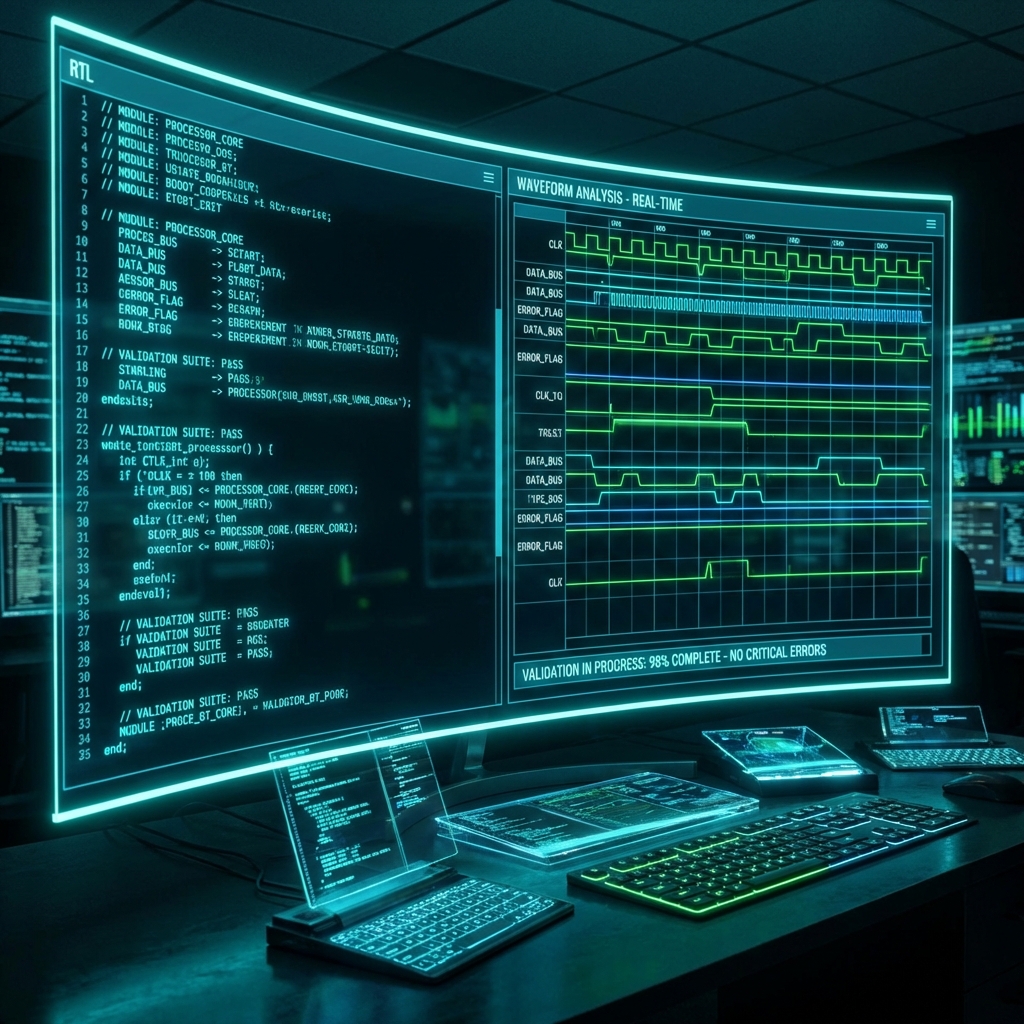
Students work on carefully designed RTL and FPGA projects that reflect real control logic, protocols, and datapath blocks used in modern chips.
Objective Skill Evaluation
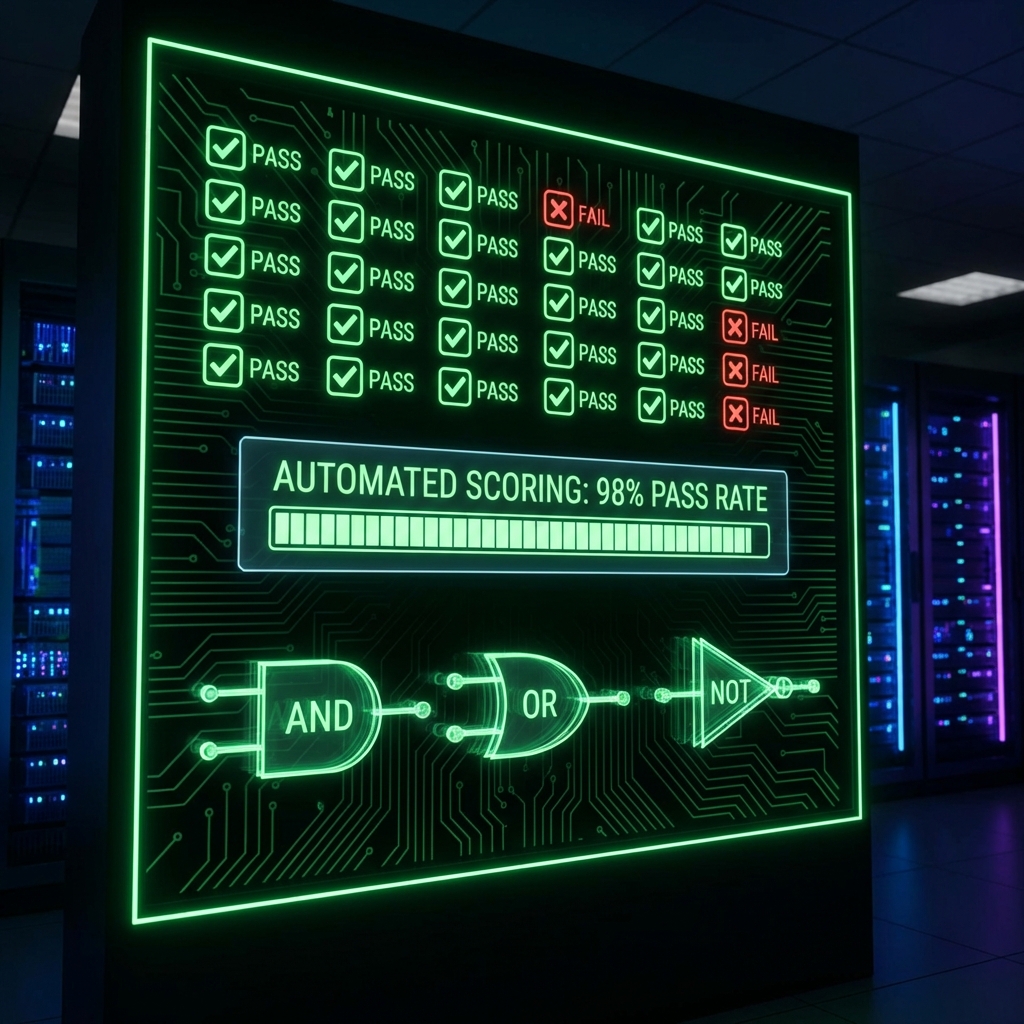
Every project is auto-evaluated using hidden testbenches. Students pass only when their logic is correct — not by guessing.
Guided AI Support (No Shortcuts)
AI tutors help students understand concepts, errors, and waveforms without generating solutions or encouraging copying.

Real FPGA Exposure
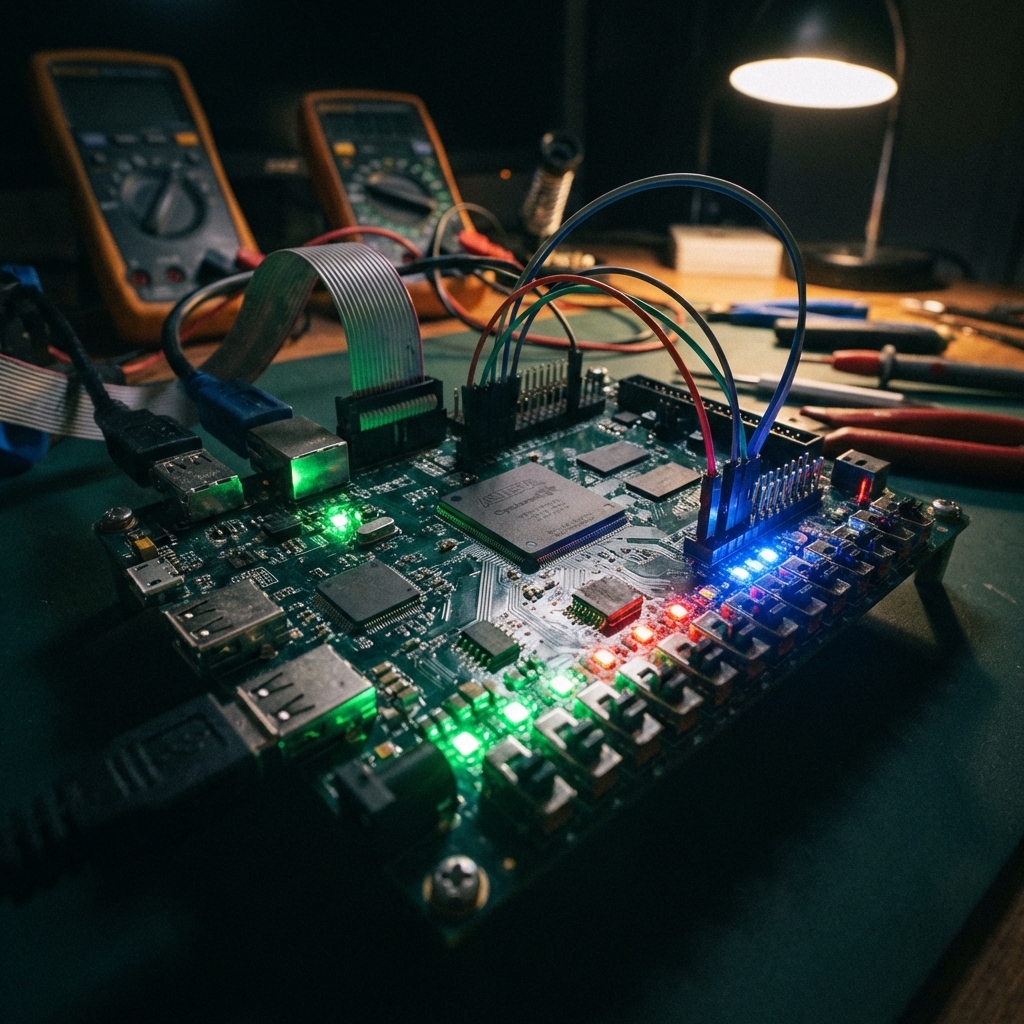
Students are validate their designs on 3D FPGA hardware for deeper confidence and proof.
What Students Actually Gain
Real capability, not just certificates.
Write RTL Independently
Build confidence to design hardware logic from scratch without copying templates.
Debug Like an Engineer
Learn industry debugging methods using waveforms and simulation analysis.
Understand Hardware Deeply
Develop intuition for control logic, data flow, and protocol behavior.
Industry-Ready Experience
Work on real RTL blocks like FIFOs, interfaces, and control units.
Validated Certificate
Earn a certificate backed by actual skill demonstration, not just completion.
Overcome the Fear
Clear structure and guided learning removes overwhelm and builds clarity.
They don't just complete projects — they prove real hardware skills.
How It Works
A clear, structured path from learning to validated proof.
Learn Only What’s Required
Students are introduced to short, focused theory modules designed only for the current project. There is no unnecessary academic depth or memorization.
The goal is simple:
Understand just enough to build the logic correctly. If a concept is unclear, an AI tutor helps explain it — without moving ahead or revealing solutions.
Watch and Understand with Context
Each project includes short, purpose-driven videos that visually explain how the logic behaves.
If a student gets stuck at a specific moment in the video, the AI tutor can explain that exact part, as if a mentor were watching alongside them. This keeps learning focused and frustration low.
Build the RTL in a Controlled Workspace
Students write their RTL inside a dedicated workspace built for simulation and debugging.
- › write Verilog code
- › run simulations
- › observe outputs and waveforms
There are no shortcuts — the logic must be written and understood by the student.
Visualize on Interactive 3D FPGA
After RTL verification, students validate their design on a physics-based 3D FPGA board.
- › flash the bitstream
- › toggle switches & buttons
- › verify LEDs & displays in real-time
This bridges the gap between code and hardware, ensuring the design works in reality.
Debug with Guided Support
When something goes wrong, students don’t get vague failure messages. They receive:
- clear execution status
- compiler and runtime feedback
- FPGA 3D integration
- guidance from an AI tutor that helps reason through the issue
The AI explains why something failed — but never writes the solution.
Validate Through Objective Evaluation
Once the design is complete, it is evaluated automatically using hidden testbenches.
Only designs that behave correctly across all required conditions pass.
There is no manual bias and no partial credit for incomplete logic.
Earn Proof of Skill
After completing all required projects successfully, students earn a certificate that represents validated RTL and FPGA capability.
Optional FPGA-based validation adds an extra layer of confidence for students who choose to go further.
The platform is designed to guide students through real engineering work — step by step — without shortcuts or guesswork.
Why This Platform Is Different
Most platforms teach VLSI.
This platform validates engineering capability.
Most existing VLSI learning platforms are designed to deliver content. They help students understand concepts, but often stop short of proving whether the student can actually apply that knowledge.
This platform is designed for a different purpose — skill validation through execution.
Learning helps students understand concepts.
Validation proves that students can do real engineering work.
Built with real industry expectations in mind.
Traditional Learning Platforms
- • Focus on lectures and theory
- • Projects are optional or lightly evaluated
- • AI often gives direct answers
- • Certificates issued for completion
- Skill level is hard to verify
Our Skill Validation Platform
- Project-first, execution-focused design
- Auto-evaluation using hidden testbenches
- AI explains thinking, not solutions
- Certificates issued only after validation
- Clear proof of engineering capability
Skill Validation
Prove your expertise. Build, simulate, and debug to earn your certificate.
Virtual Certification
- ✓ Complete project code
- ✓ Pass simulation
- ✓ Clear portal quiz
Award
Immediate System Generated Certificate
Free One-Day RTL & FPGA Workshop
An on-campus introduction to real hardware design — not just theory.
We conduct free one-day workshops at engineering colleges to introduce students to the fundamentals of RTL design and FPGA-based hardware development. The workshop is designed to help students see, understand, and experience how digital hardware is actually built and validated — beyond textbooks and slides.
What Students Will Learn
Introduction to RTL Design
Students are introduced to how hardware logic is written using RTL, and how it differs from software programming.
Understanding FPGA Hardware
Students learn what an FPGA is, how it works internally, and why it is widely used for prototyping and validation in industry.
From Code to Hardware
We demonstrate how RTL code is synthesized, simulated, and deployed onto a real FPGA board. This helps students connect code → logic → physical behavior.
Common Beginner Mistakes
We discuss typical errors beginners make in RTL design and how to avoid them early.
Live FPGA Demonstration
During the workshop, students see real FPGA boards in action. This hands-on exposure removes fear and builds curiosity.
- Flashing RTL designs onto the board
- Observing real outputs (LEDs / serial output)
- Understanding how simulation relates to hardware behavior
Why This Workshop Matters
For many students, this is the first time they see real hardware respond to their logic, understand how RTL connects to physical systems, and realize that VLSI is approachable with the right guidance.
The workshop focuses on clarity and confidence, not overwhelming depth.
Next Steps for Students
At the end of the workshop, students are introduced to the platform as a way to practice what they learned, build real RTL projects, and validate their skills objectively.
There is no pressure to enroll — only a clear next step for interested students.
For Colleges & Faculty
This workshop helps colleges expose students to practical RTL & FPGA concepts, complement academic curriculum, and identify motivated students.
The workshop is free. The experience is real.
The learning is practical.
Talk to Our Team
Have questions or want to explore how this fits your students or institution? Let’s talk.
Whether you are a student curious about hands-on RTL learning, a faculty member looking to strengthen practical exposure, or an institution exploring skill validation programs — we’re happy to have a conversation. We believe good decisions come from clear understanding, not pressure.
We’re building this platform carefully — with students and colleges in mind.
© 2026 vl-easy. All rights reserved.